Baptismal Preparation
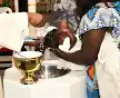
According to the Catechism of the Catholic Church (CCC 1213), Holy Baptism is the foundation of the entire Christian life, the gateway to life in the Spirit, and the door that gives access to the other sacraments.
Core Meaning and Symbolism
- Rebirth and Cleansing: Baptism frees the person from original sin and all personal sins, granting rebirth as an adopted child of God.
- Incorporation: It unites the believer into Christ’s Mystical Body and makes them a member of the Catholic Church.
- Indelible Character: It imprints a permanent spiritual seal (character) on the soul, meaning the sacrament can never be repeated.
Essential Rite and Form
- Matter and Form: The essential rite requires immersing the candidate in water or pouring water three times over their head while reciting the Trinitarian formula: “I baptize you in the name of the Father, and of the Son, and of the Holy Spirit”.
- Ministers: Bishops, priests, and deacons are the ordinary ministers, though in an emergency anyone with the right intention can baptize.
For an infant to be baptized in the Catholic Church, the Code of Canon Law (Canon 868) requires parental consent and a founded hope that the child will be brought up in the Catholic religion. If that hope is altogether lacking, the baptism is deferred according to local diocesan rules.
Core Requirements for Parents
- Parental Consent: At least one parent, or the person who lawfully takes their place, must give consent for the baptism.
- Commitment to Catholic Upbringing: Parents must intend to raise the child in the Catholic faith, which typically includes participating in Mass and preparing the child for future sacraments.
- Baptismal Preparation: Our parish requires parents and godparents to attend a short baptismal preparation class before scheduling the ceremony.
- Documentation: Parents must provide a copy of the child’s birth certificate and, depending on the parish, proof of their own Catholic sacraments or parish registration. No baptism will be scheduled until all paperwork for parents and godparents is submitted and approved by the parish office.
Godparent (Sponsor) Requirements
Under Canon 874, a child must have at least one Catholic godparent (or one godfather and one godmother) who meets these criteria:
- Age: Must be at least 16 years old, unless the local bishop sets a different age or the pastor grants an exception.
- Sacraments: Must be a fully initiated Catholic who has received Baptism, Confirmation, and First Holy Communion. If married, the marriage must have been celebrated in a Catholic church (see below).
- Practicing Faith: Must lead a life of faith in harmony with the Church’s teachings and the role they are taking on.
- Not a Parent: Cannot be the father or mother of the child being baptized.
(Note: A baptized non-Catholic Christian may participate alongside a Catholic godparent as a “Christian witness,” rather than a formal godparent. A baptized Catholic who has left the faith can not be a Christian Witness)
How Many Godparents You Can Have
- Standard Limits: You may choose one godparent (male or female) or two godparents.
- Gender Rule: If you choose two godparents, Canon 873 specifies that there must be one godfather and one godmother. You cannot have two godfathers or two godmothers.
Eligibility Criteria for a Catholic Godparent
- Designated Role: They must be chosen by the parents (or the person being baptized) and have the ability and intention to fulfill the role.
- Minimum Age: They must have completed their 16th year, unless the local bishop has established a different age or the pastor makes an exception for a just cause.
- Full Initiation: They must be a Catholic who has received all three Sacraments of Initiation: Baptism, Confirmation, and First Holy Communion.
- Practicing Catholic: They must lead a life of faith in harmony with the Church’s teachings, including attending Sunday Mass regularly and—if married—being in a marriage recognized as valid by the Catholic Church.
- Not the Parent: The father or mother of the person being baptized cannot serve as a godparent.
- Canonical Standing: They cannot be bound by any canonical penalty (such as excommunication).
Rules for Non-Catholics (Christian Witnesses)
- Non-Catholic Christians: A baptized person who belongs to a non-Catholic Christian community (such as a Protestant or Orthodox church) cannot be a formal godparent, as they do not share full communion with Catholic teachings.
- Christian Witness Role: They may participate in the ceremony as an official “Christian witness,” provided there is also at least one qualified Catholic godparent.
- Non-Christians: Unbaptized individuals (such as those of Jewish, Muslim, or non-religious backgrounds) cannot serve as either a godparent or a Christian witness.
Parish Paperwork
- Sponsor Certificate: Our parish requires prospective godparents to obtain a signed Letter of Good Standing (Sponsor Certificate) from their own home parish confirming they meet these requirements.
- Proxy Option: If a chosen godparent cannot attend the baptism in person, another person can stand in as a proxy during the ceremony while the godparent’s name is still recorded in the baptismal register.
If a prospective godparent is married outside the Catholic Church or has not yet received Confirmation, they are generally not eligible to serve as a formal Catholic godparent under Canon Law (Canon 874). Because a godparent is meant to represent the Church and model a full Catholic sacramental life, pastors are bound by Church law when signing a Sponsor Certificate.
However, both situations have common paths forward depending on the timeline and the person’s willingness to regularize their status.
1. Married Outside the Church
- Why It Disqualifies Them: Catholics are bound by canonical form, meaning they must marry before a Catholic priest or deacon (unless they received a formal dispensation from their bishop beforehand). A civil ceremony or a wedding in a non-Catholic church without permission is not recognized as a valid marriage by the Church, which places the person out of full sacramental communion.
- The Fix (Convalidation): If the couple is open to it, they can speak with their local priest about having their marriage convalidated (blessed/recognized in the Catholic Church). If neither spouse has a prior marriage requiring an annulment, this process can sometimes be completed relatively quickly.
- Temporary Workaround: If the baptism cannot wait, you can select another eligible Catholic to serve as the official godparent on record, while still inviting the couple to play a special, unofficial role in the child’s life.
2. Missing a Sacrament (Usually Confirmation)
- Why It Disqualifies Them: Canon 874 explicitly requires a sponsor to have received all three Sacraments of Initiation: Baptism, First Holy Communion, and Confirmation. There is no canonical waiver for lacking Confirmation.
- The Fix (Adult Confirmation): Our parish Offers OCIA Order of Christian Initiation for Adults specifically for baptized Catholics who already attend Mass and received First Communion.
- Timeline Consideration: If the baptism is months away, the person may have enough time to complete Adult Confirmation before the ceremony.
To attend a session, please register at the Parish Office.
Ministry Contact
Parish Office
Email
732-370-0500 ext. 204